
Texas-Style Smoked Pork Belly (Low and Slow, No Wrap)

Last tested on: 4/06/2026
Texas-style smoked pork belly is a 4–5 pound skinless slab seasoned with salt, pepper, and garlic, smoked fat-side up at 250°F for 4–5 hours with no wrap until probe-tender at 200–210°F. The no-wrap method builds a firm, pepper-forward bark — the same way Texas pitmasters treat brisket. Each slice is rich, deeply smoky, and somewhere between bacon and brisket in the best way possible.
I’ve smoked this more times than I can count. It’s one of the easiest cooks in barbecue — no stall drama, no wrap debate, no complicated technique. You season it, put it in the smoker, and leave it alone. The hard part is waiting.
Love smoked pork belly recipes? Make sure you check out Pork Belly Burnt Ends as well, they are irresistible.

Why This Method Works
Wrapping is optional with pork belly. I skip it, and here’s why.
- Bark stays intact. Foil creates steam, which softens the crust you spent 4 hours building. Pink butcher paper at rest is fine. Foil on the smoker is not.
- Fat renders completely. Pork belly has enough intramuscular fat that the goal is full render, not moisture retention. At 250°F, the heat breaks down the fat without seizing the exterior before the interior catches up.
- Simpler is better here. Pork belly has enough intramuscular fat to stay moist without intervention. The fat-to-meat ratio does the work for you.
What to Look for at the Butcher
Not all pork belly slabs are equal. A few things to check before you buy:
- Skinless. Buy skinless. If yours has skin, remove it before seasoning.
- Size. 4–5 pounds minimum. Thin strips won’t work with this method. You need a full slab.
- Color. Fat should be creamy white. Yellow or grey fat means it’s aging. The meat should be pink, not brown or grey.
- Marbling. Look for an even distribution of meat and fat, roughly 50/50. Mostly fat means a greasy finish. Mostly lean means it’ll dry out.

Key Ingredients
- Kosher salt. Coarse texture sticks to the meat and draws moisture to the surface during the dry brine. Table salt is too fine and will over-season the surface.
- 16-mesh black pepper. Medium-coarse grind. The standard for Texas-style BBQ. It gives you visible pepper crust without turning to powder during the cook. Pre-ground from the grocery store is too fine.
- Granulated garlic. Not garlic powder. Granulated stays on the surface and doesn’t clump.
- Smoked paprika. Adds color and depth. A small amount goes a long way.
Start with a 2:1 ratio of black pepper to Kosher salt, from there you can add your other flavors. Extra pepper works best with pork, especially a thinner cut such as pork belly.
Want to skip the measuring? Canyon Crust is built on the same salt and pepper foundation. Same flavor profile, same application, same dry brine time. Just shake it on.
Other seasoning options: My Signature Sweet & Smoky Rub works here if you want a deeper, sweeter bark. The Korean BBQ Seasoning builds a bolder, spicier crust. Both are solid depending on what you’re serving alongside.
How to Smoke Pork Belly: Step-by-Step
Step 1: Prep and Season
Slice the slab in half along the width. This is optional, but it cuts cook time, gives you more seasoned surface area, and makes it easier to handle on the cutting board later. Each piece should be 2–3 pounds.
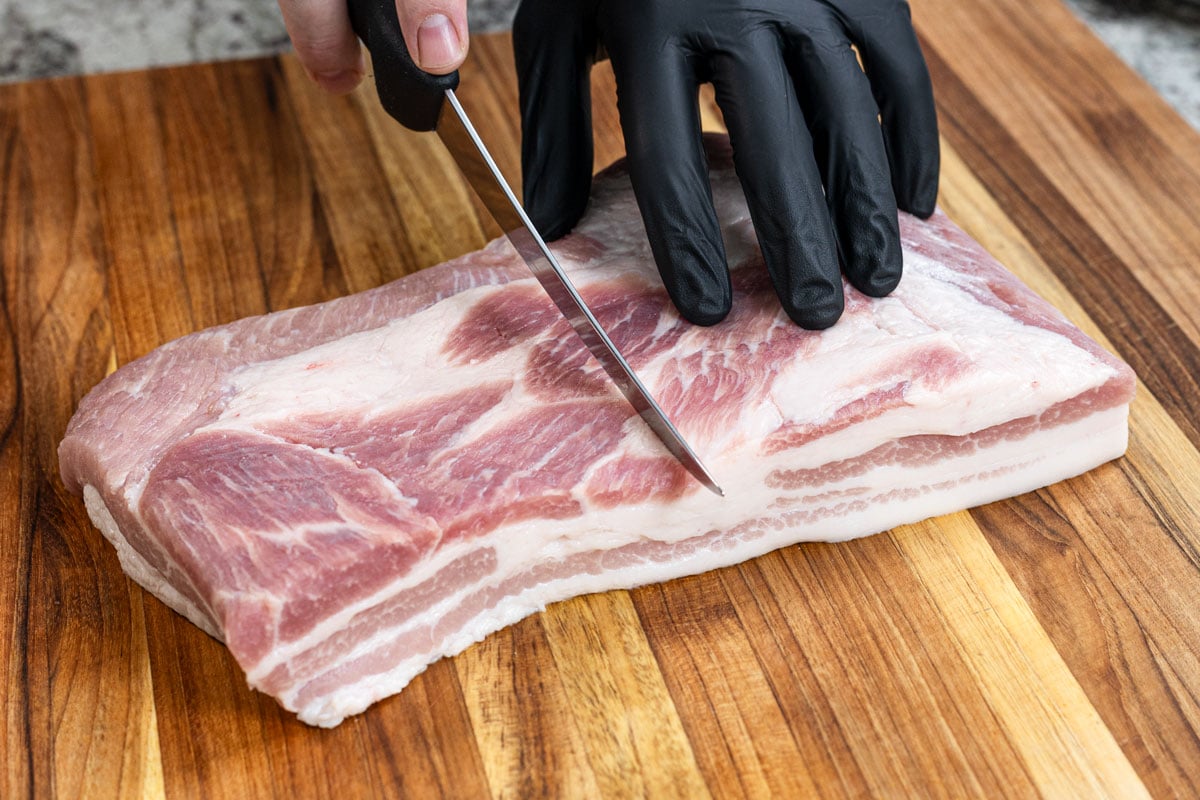
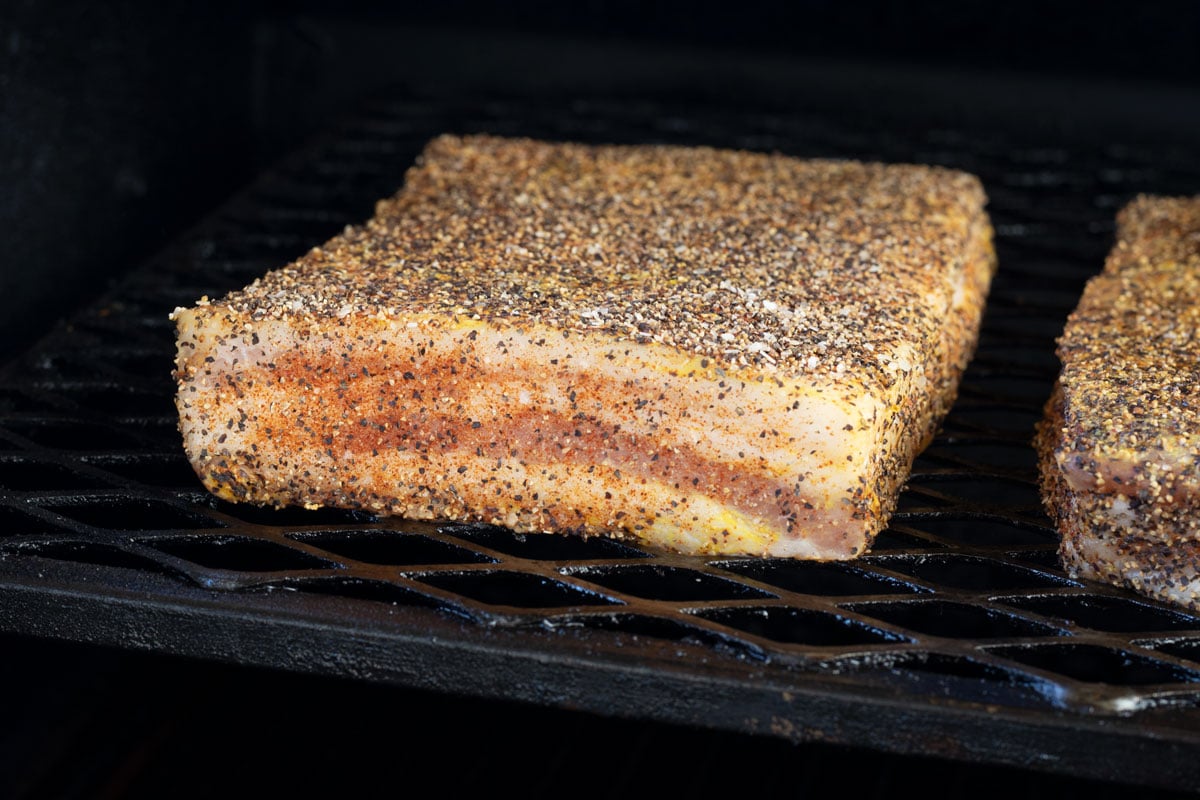
Apply a thin layer of yellow mustard or hot sauce as a binder. Not for flavor, just to give the rub something to stick to. Season all sides generously with the Texas dry rub. Let it rest at room temperature for at least 30 minutes. For better bark and moisture control, season the night before and leave it uncovered on a wire rack in the fridge.

Step 2: Get the Smoker to 250°F
Set your smoker, pellet grill, or charcoal grill to 250°F. For charcoal, build a two-zone setup. Indirect heat only for this cook. Wood choice matters: Post oak is the Texas standard. Hickory gives you that bacon flavor. Cherry adds sweetness without overpowering the pepper crust.
If you dry-brined overnight, take the pork belly out of the fridge while the smoker comes up to temp. Cold meat on a hot smoker is fine. It extends the time smoke can penetrate before the surface sets.
Step 3: Smoke Fat-Side Up
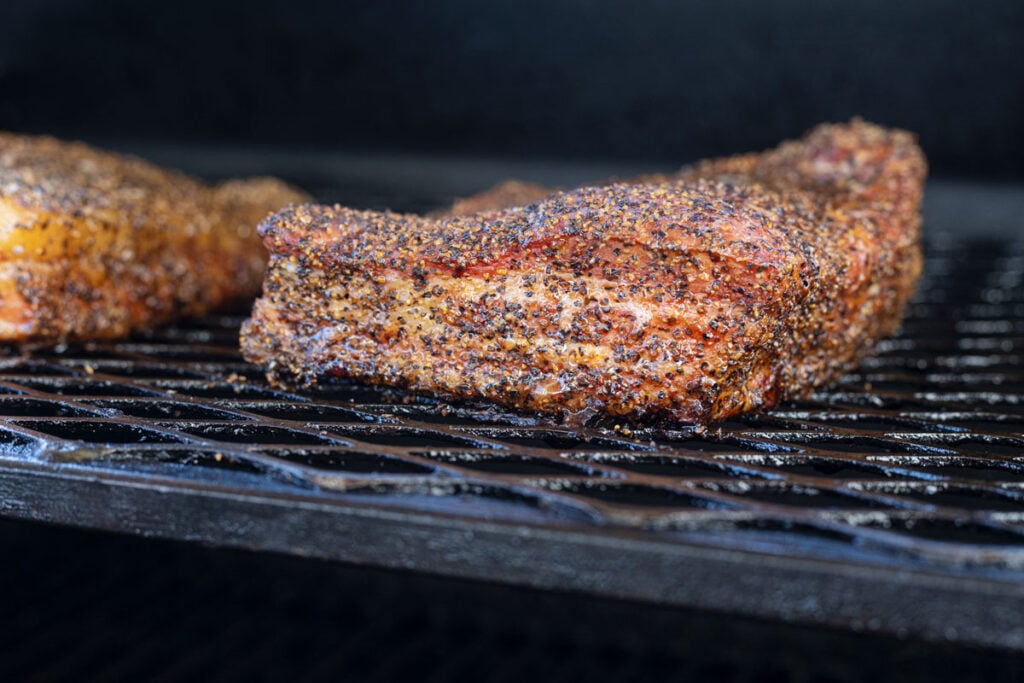
Place the pork belly in the smoker fat-side up. Leave it alone for 4–5 hours. No flipping, no spritzing unless the edges start to look dry. The more the fat renders, the better. 250°F breaks it down fully without seizing the exterior before the interior has a chance to catch up.
Liquid pooling on top is normal. Just tilt the slab gently and let it run off. Edges drying out is rare, but a quick spritz of apple cider vinegar fixes it. Otherwise, leave the lid shut.

Start checking for tenderness around 200°F internal temp. The probe should slide through with almost no resistance, like pushing into a jar of peanut butter. If it catches, give it another 30 minutes. Temperature is a guide, not the finish line.
Step 4: Rest, Then Slice
Pull the pork belly off the smoker at 200–210°F internal temp. Wrap loosely in pink butcher paper, not foil. Rest at room temperature for 45 minutes. Pink butcher paper is porous enough to allow it to cool slowly without compromising the hard work you’ve put into that crispy bark.
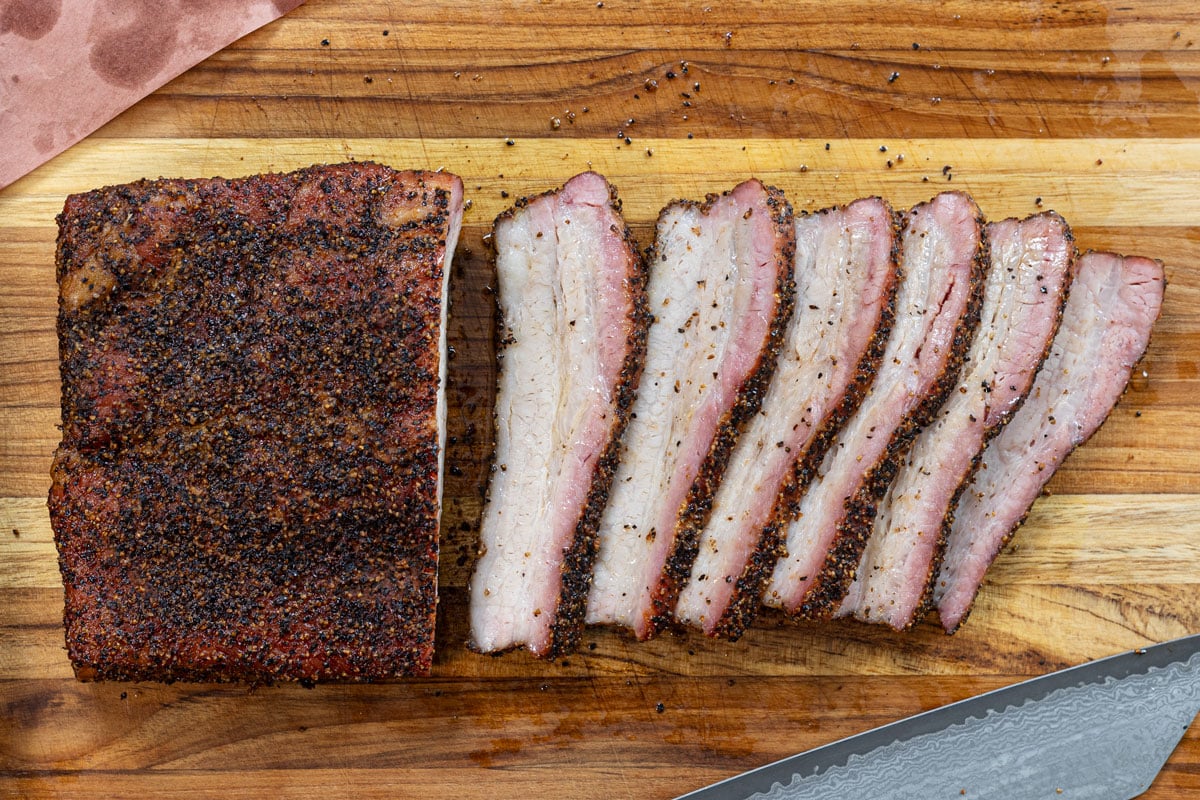
Slice along the width into ¾-inch to 1-inch pieces. Use a sharp knife or a brisket slicer. If the fat is shredding instead of slicing clean, the resting period was too short.

Step 5: Slice and Serve
Finally, the payoff! Slice along the width, and let the party start.
The pork belly slices can be served immediately with sides, piled onto sandwiches, or even pan-fried to a crisp for breakfast. Endless recipe options create some delicious meal opportunities with smoked pork.
Pro Tips from the Pit
- Don’t slice before storing. Keep the slab whole or in large pieces. Once you slice it, it dries out faster. Vacuum-sealed pieces last a week in the fridge, months in the freezer.
- Dry brining overnight is worth it. 30 minutes works. Overnight is better. The salt draws moisture out of the meat and then pulls it back in. Time in the fridge also lets the exterior dry out in the cool air, which is what gives you a deeper, crustier bark when it hits the smoker.
- Fat-side up is non-negotiable. Fat-side down risks sticking to the grates and tearing off the bark when you try to move it.
- Temperature is a guide, not the signal. Start probing at 200°F. The slab is done when the probe meets no resistance, not when the thermometer hits a specific number. Some slabs finish at 198°F. Some need 212°F. Trust the probe.
- Crispy pork belly slices are a different technique. Smoke the slab, chill overnight, then slice cold and finish in a cast iron skillet or over direct coals. The overnight chill firms up the fat so it crisps instead of shredding.
What to Serve With Smoked Pork Belly
Smoked pork belly is quite rich, and pairs well with various sauces and sides to round out a great meal.
- Quick Pickled Jalapeños — acid cuts through the fat, heat wakes up the pepper crust.
- Smoked Mac and Cheese — the obvious pairing, and for good reason.
- Creamy Southwestern Coleslaw — cool and crunchy against the smoke.
- Tangy Blue Cheese Coleslaw — grab a bottle of hot sauce, and you’ve got quite the pair.
- Sweet and Spicy Pickles — especially good if you’re building sandwiches.
- Smoked Baked Beans — a natural complement on the same smoker.

Frequently Asked Questions
At 250°F, a 4–5 pound skinless pork belly slab takes 4–5 hours. Smaller slabs run closer to 3.5–4 hours. Start probing for tenderness at 200°F internal temp. The probe sliding through with little resistance is your done signal, not the clock.
Pull it at 200–210°F when the probe slides through with almost no resistance. That range is where the intramuscular fat has fully rendered and the collagen has broken down. Below 195°F the texture is often still tough. Above 215°F you risk it going mushy.
No, not for this method. Wrapping in foil traps steam and softens the bark. The fat content in pork belly provides enough natural moisture that wrapping is unnecessary. Wrap loosely in pink butcher paper during the rest period only. Butcher paper is porous enough to let steam escape while slowing the cool-down.
Yes, and it’s worth doing. Slice into ½-inch pieces and sear in a cast iron skillet over medium-high heat for 2–3 minutes per side. The exterior crisps like thick-cut bacon. This is also how you reheat leftovers. Skip the microwave entirely.
Post oak is the Texas standard. Clean smoke, neutral backbone, doesn’t fight the pepper rub. Hickory is bolder and works well if you want more smoke presence. Cherry adds sweetness and gives the bark a darker color. Avoid mesquite for a long cook like this. It can turn bitter over 4+ hours.
Equipment Used
- Smoker or pellet grill — any style works at 250°F. I use an offset smoker for this one. A charcoal kettle with a two-zone setup is a close second.
- Instant-read thermometer — for checking internal temp. A leave-in probe works too.
- Sharp slicing knife or brisket slicer — the difference between clean slices and shredded fat.
- Pink butcher paper — for the rest, so it can stay warm with minimal steaming. Avoid foil.
How to Store Smoked Pork Belly
Don’t slice everything before storing. Larger pieces hold moisture better than individual slices.
Vacuum seal for the longest shelf life. Up to a week in the fridge, several months in the freezer. No vacuum sealer? Wrap tightly in plastic wrap, then foil, and use within 4–5 days.
To reheat: Cast iron skillet over medium heat, a couple of minutes per side. Worth noting: pork belly fat softens overnight, so the texture will be different than right off the smoker. Both are good. If you’re cooking for a group, serve it fresh. If you’re cooking ahead and slicing to order, leftovers hold up well.
Try It and Tag Us
Smoked this one? Leave a rating and a comment below. It helps other people find the recipe, and I read every one. Tag us on Instagram so I can see your smoke ring and bark.

Texas-Style Smoked Pork Belly
A whole pork belly slab seasoned with salt, pepper, and garlic, smoked fat-side up at 250°F for 4–5 hours with no wrap. Probe-tender at 200–210°F. Slices like a brisket, tastes like the best bacon you’ve ever had.
- Total Time: 6 hours
- Yield: About 20 1x
Ingredients
- 4 to 5 pounds pork belly slab, skin removed
- Yellow mustard or thin hot sauce (binder, optional)
Texas Dry Rub:
- 1/3 cup kosher salt
- 2/3 cup 16-mesh black pepper (medium-coarse)
- 1 tablespoon smoked paprika
- 1 tablespoon granulated garlic
Instructions
- Season the pork belly on all sides generously. Let it rest for at least 30 minutes, or dry-brine overnight on a wire rack uncovered in the fridge.
- Preheat the smoker to 250°F. Place the pork belly fat-side up.
- Smoke for 4–5 hours, undisturbed. If liquid pools on top, tilt the slab gently to let it run off. If edges look dry, spritz once with apple cider vinegar.
- Start probing at 200°F. The slab is done when a probe slides through with almost no resistance. This typically happens between 200–210°F.
- Remove from the smoker and wrap loosely in pink butcher paper. Rest at room temperature for 45 minutes.
- Slice along the width into ¾-inch to 1-inch pieces with a sharp knife.
Notes
- The rub recipe makes enough for 2 batches. Store the remainder in a sealed jar.
- Temperature is a guide. Probe tenderness is the real signal. Start checking at 200°F internal temp.
- Reheat leftovers in a cast iron skillet over medium heat. Skip the microwave.
- Freeze vacuum-sealed pieces for up to several months.
- Prep Time: 10 minutes
- Rest Time: 45 minutes
- Cook Time: 5 hours
- Category: Pork
- Method: smoking
- Cuisine: Barbecue, Texas BBQ
- Diet: Gluten-Free, Low-Carb
Nutrition
- Serving Size:
- Calories: 473
- Sugar: 0 g
- Sodium: 401.2 mg
- Fat: 48.2 g
- Carbohydrates: 0.4 g
- Protein: 8.6 g
- Cholesterol: 65.4 mg

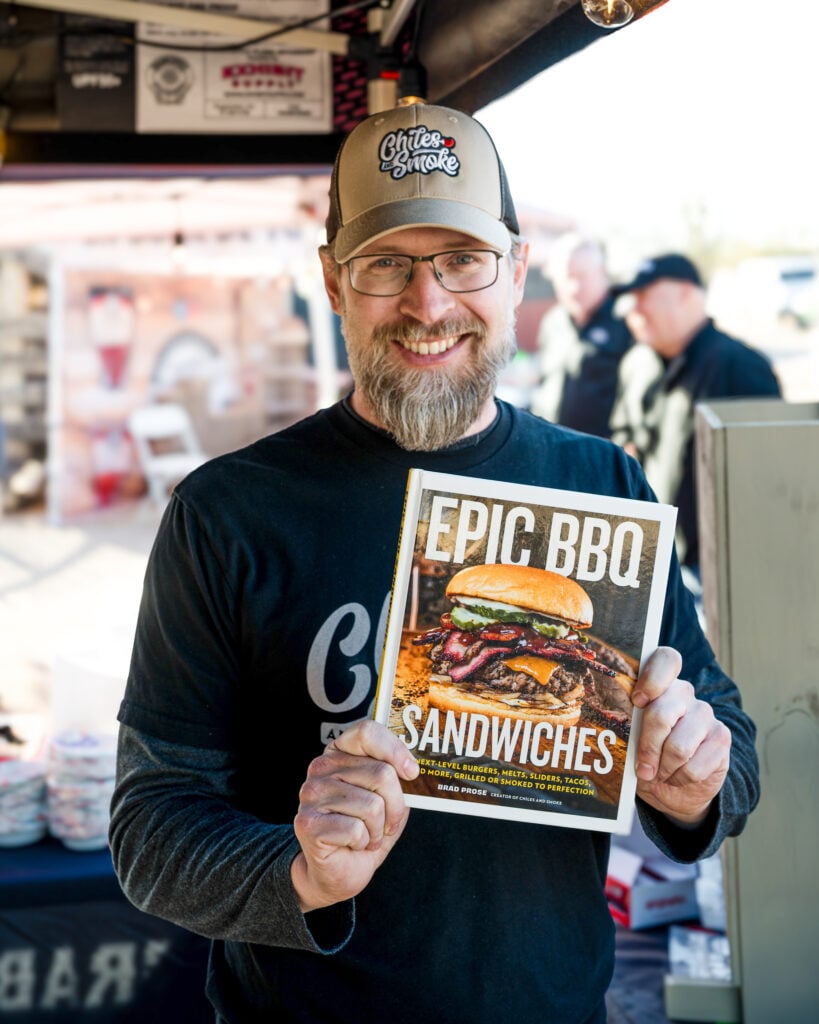
Brad Prose has been crafting recipes over live fire for 20 years. He’s the author of two cookbooks, Chiles and Smoke and Epic BBQ Sandwiches, and the creator of the original smash burger taco, as credited by the Washington Post, TODAY Show, Good Morning America, and Food Network. Brad is the force behind Chiles and Smoke, the home of Sonoran BBQ: bold flavors built around chiles, smoke, and the traditions of the American Southwest. Follow along on Instagram, YouTube, and Facebook.


Came out great, maybe move the note about the rub making enough for 2 pork bellies. I made it and didn’t see the note till I was trying to figure out why it was so salty. Luckily I only used 3/4 of the rub.
Good suggestion, will update!
This pork belly is hands down the juiciest I’ve ever had! We sliced up some thin for breakfast the next day and made the best egg sandwiches ever. Absolutely will be keeping this handy. Thank you!